Tokyo Tech Talks #4: AI, Agents, and Strange Loops
A recap of Tokyo Tech Talks #4 at Build+ in Ebisu, where Mitchell A. Carroll explored self-reference, feedback loops, and why agentic AI feels different from ordinary software.
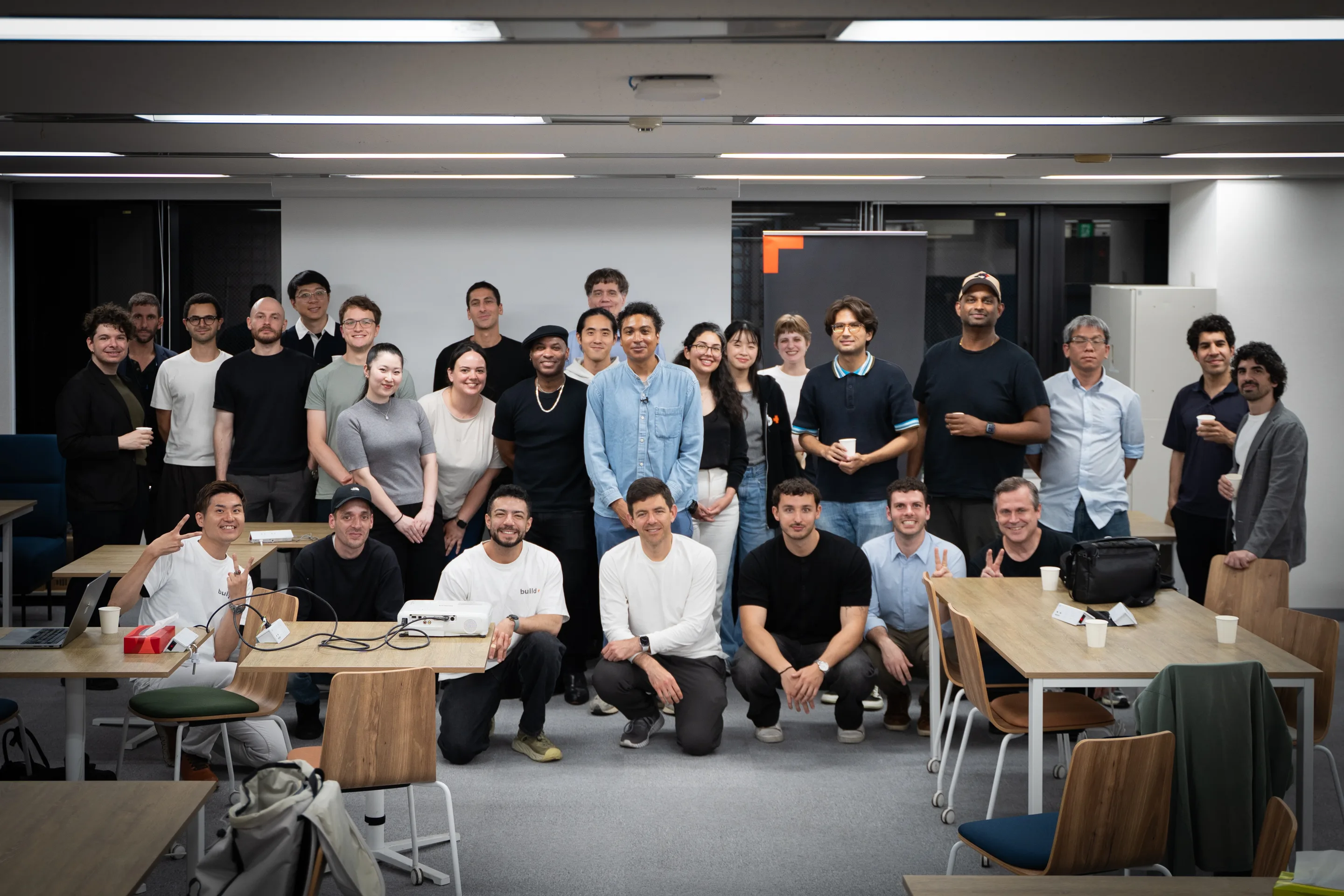
On May 26, 2026, we held Tokyo Tech Talks #4 at Build+ in Ebisu. The theme was Closing the Loop: what changes when a system can observe what it just did, reason over the result, and try again.
Mitchell A. Carroll anchored the evening with AI is a Strange Loop, a talk that connected Douglas Hofstadter’s idea of strange loops to modern AI agents. A strange loop is a self-referential structure: you move upward through a hierarchy and somehow arrive back where you started. In people, that recursion helps explain the feeling of “I.” In software, Mitchell used it as a way to understand the shift from static tools to systems that feel like actors.
From Prediction to Agency
The useful distinction in the talk was not that an LLM can produce text. We already know that. The interesting part is what happens when the model’s output becomes part of the next input.
An ordinary model call predicts a response and stops. An agent gets wrapped in a loop: observe the situation, reason about a plan, act through a tool or command, evaluate the result, then continue. That small architectural change does a lot of work. It lets the system revise itself, notice failed steps, and carry a goal across more than one move.
That is why agentic software can feel qualitatively different from a chatbot. The “agency” is not only in the model. It is in the recursive system around it.
The Loop Is the Behavior
One of Mitchell’s examples was the familiar camera pointed at its own monitor. Neither the camera nor the screen contains the fractal behavior on its own. The complexity appears because the output is being fed back as input.
That framing landed well for AI agents. Memory, tool use, evals, retries, user feedback, and synthetic data all become part of the same shape. We are not just building smarter functions. We are building loops that can change their next move based on what happened last time.
The harder question is how much of that loop we can still understand once it runs at scale. If agents produce more of the digital world that future models train on, AI starts shaping the reality it later observes. The feedback stops being local and becomes cultural.
What Stuck With Us
The best part of Tokyo Tech Talks is the conversation after the slides, and this topic gave people plenty to work with.
When does a system become more than code? How do we design agents that can critique themselves without drifting away from the user’s intent? If a recommender, agent, or workflow assistant changes our behavior, who is steering the loop?
Those questions do not have tidy answers, but they are exactly the kind of questions worth asking in a room full of builders. Closing the loop gives software power. It also gives us responsibility for the shape of the loop, what it observes, what it remembers, and what it is allowed to optimize.
You can download Mitchell’s slides here: AI is a Strange Loop.
Looking Ahead
Tokyo Tech Talks is becoming a place for practical, strange, useful conversations about the systems we are all starting to build around. #4 made one thing feel very clear: the next wave of AI work will not be defined only by bigger models. It will be defined by the loops we put those models inside.
Thanks to everyone who joined us in Ebisu. If you missed this one, keep an eye on upcoming events.